I am being way judgmental here, and not going to apologise for it! My THIB (thinks he is boss!) showed me an article in the Sunday paper - with the above title.
A couple, who have two little boys, went to USA for the honeymoon they 'never had'. She was 24 weeks pregnant. To cut a long story short, the baby decided to pop out early, at 24 1/2 weeks. Mum is now stuck in Orlando, Florida, with her prem baby Gracee in hospital, while Dad has returned to Brisbane.
The couple had holiday insurance with AAMI but the company said that "Gracee was not covered by their policy because she did not exist at the time of cover". AAMI is also refusing to pay Mum's medical bills, as she had a "pre-existing condition" - i.e., pregnancy.
According to the news report, it is costing approximately $5,000 a day, PLUS doctor's and specialist's fees for Gracee. Mum's hospital bill, for three days, was $30,000. So far the bill for baby Gracee has reached $300,000. It is expected she will need to remain in hospital for a further 60 to 80 days.
Added to the silliness already racked up is the fact that as Gracee was born in USA she cannot enter Australia until she has a Visa. That I find quite strange and rather extraordinary - after all, my daughter was born in UK and yet I registered her birth with the Consulate and she automatically became an Australian Citizen.
Something about this is either a bit off or mis-reported. I guess it must be something to do with the laws in USA?
There is now a campaign to raise money to help the couple and their baby. They have paid "as a show of good faith" $10,000 toward the medical costs.
Now comes my judgement ok? The lady in question said she already had two children who were born full term, and therefore she figured this pregnancy would go to full term. Hmmm. Didn't she realise that all pregnancies are different? There are NO guarantees, none. Anything can happen, and at any time, and often does. And I don't know about any other mums out there, but at 24 weeks pregnant, whether cleared for travel by a doctor or not, I would be sticking fairly close to home. For obvious reasons!
As far as AAMI goes? They aren't the only ones who don't cover pregnancy and childbirth, from what I read. In the AAMI Product Disclosure Statement, it is stated quite clearly that pregnancy and childbirth will not be covered.
One of the comments I have read about this unfortunate incident says "An unfortunate gamble by these parents, that has ended up costing them for the rest of their lives.. "
Me? I just think they were irresponsible. And they obviously aren't the smartest pair on the block........
Two morals - read the damned document, and don't travel 12 hours on a plane when you are so far advanced in your pregnancy....
Showing posts with label Babies Children and Parenting. Show all posts
Showing posts with label Babies Children and Parenting. Show all posts
Monday, April 9, 2012


Friday, March 9, 2012
3 Year Old Run Over And Killed
This is the saddest story I have read for quite a while, and I am sending my thoughts and love to the community where this happened.
Last night, 8th March, in a suburb near Cairns, Nth Queensland, a 3 year old was run over by two cars, and died later in Cairns Base Hospital. The little boy was disabled, and could not walk.
Apparently a door didn't close properly when someone went outside, and the little boy crawled out and into the road. It was about 8.40 p.m. and the drivers of the two vehicles had little hope of seeing the small boy, who was wearing dark clothing. It appears that he was hit by one car, and thrown into the path of the second.
Shocked and desperate neighbours tried to resuscitate little Lachlan, whose foster father was distraught.
A police spokeswoman, Sergeant Coolican, said "Everyone involved in the incident is terribly upset, and that includes police and paramedics who did attend and the people involved in the car crash".
Last night, 8th March, in a suburb near Cairns, Nth Queensland, a 3 year old was run over by two cars, and died later in Cairns Base Hospital. The little boy was disabled, and could not walk.
Apparently a door didn't close properly when someone went outside, and the little boy crawled out and into the road. It was about 8.40 p.m. and the drivers of the two vehicles had little hope of seeing the small boy, who was wearing dark clothing. It appears that he was hit by one car, and thrown into the path of the second.
Shocked and desperate neighbours tried to resuscitate little Lachlan, whose foster father was distraught.
A police spokeswoman, Sergeant Coolican, said "Everyone involved in the incident is terribly upset, and that includes police and paramedics who did attend and the people involved in the car crash".
2 Year Olds To Get Lessons In Anger Management?
Dear reader, why is it that every time there is some article online which catches my attention, it is about some utterly ridiculous theory by a supposed 'expert' on children and their behaviour?
This time it was the Mail Online (or should I say, as usual it was the Mail Online?) which reported that a UK Government 'discipline expert' - a Mr. Charlie Taylor, has drawn up a proposal which was designed to "improve provision for disruptive youngsters in the wake of last summer’s riots". Fair enough so far? Sounds good doesn't it. But when you read through the article, you won't think it is quite as sensible as it sounds.

Mr. Taylor thinks that children at risk of turning to crime and aggression "can and should be identified at the age of TWO" and that children who are likely to 'go off the rails' should be "sent to specialist behavioural institutions at the age of FIVE - to stop their bad behaviour escalating"??
The most frightening thing about this is that the article states that Mr. Taylor's report was likely to be endorsed in full by the government. Mr. Taylor does not hesitate to say that he thinks nurseries should be able to spot the ones who have behavioural 'issues' and to then "provide them with boundaries and social skills". Hello, hello? That is what we parents strive mightily to provide for our kids!

I don't know about you Mr. Taylor, even if you are the headmaster of the Willows School - I sincerely doubt whether you have had experience of an ordinary toddler going through the 'terrible twos' or threes or fours come to that. In my humble opinion it is simply not logical thinking to believe that we can identify future problem kids at age two. I mean, for pity's sake, these are BABIES, who are learning what the word 'no' means, and learning that they actually have a separate identity from their mum. They are bound to be little horrors at time, it is all part and parcel of the growing up process.
If some nosy do-gooder like you told me that my two year old needed to be put into a 'specialist nursery' - well, gee I would want to give you the other side of my tongue to be honest. As for your totally ridiculous statement about "some difficulties around speech and language very often as well. Often not potty trained". The article didn't state at what age the kids weren't potty trained, or at what age they had difficulties with speech and language - but surely you simply CAN'T be talking about two and three year olds? Surely not? And what do you do about the little one who is behaving like a fruit loop until mum works out that she is having a reaction to chemicals in her food? (And it took one of my daughter's acquaintances twelve months to identify and isolate 24 E numbers that were doing her child great harm.) Would you have the love or patience to do this, or would you just keep her locked up until she turned 21?

Fair enough to say that some five year olds are disruptive and probably some younger ones as well. My own reading of this situation is that you surely shouldn't be taking the children and putting them into what amounts to an institution - even if you try to get them back into mainstream school quickly. Surely the ones to be taught are the parents? Wouldn't it be far far better for schools to have parenting classes? And if a child is proving to have problems with relating to others, aggression etc., wouldn't it be better to have classes which include the parents - most of us fly by the seat of our pants, and if a few have no idea what to do when their child throws a wobbly, then show them!
About the statement you made that "the aim was to help children early ‘rather than waiting until they are throwing tables around when they are 14 or 15"? Quite a feat if you can do that, my lad. It often happens (and if you lived in the real world you would know this) that a decently brought up child falls in with some not so respectable mates at school, and peer pressure does the rest. All the early intervention in the world will not prevent this from happening. Peer pressure is mightier than the teacher, on any day of the week. And for heaven's sake don't forget hormones during the teen years!

As far as this intervention helping to prevent things like the riots happening again in the future - dream on kiddo! It wasn't toddlers and tiny tots who were doing the rioting and thieving, as you well know. It was disenfranchised youth - perhaps your government would be better served by someone working out how to help the underprivileged and the homeless, the jobless and the hopeless. While these situations exist you have the potential for riots at any time in your future, whether you tame a toddler or not.
Read more: http://www.dailymail.co.uk/news/article-2111844/Children-age-TWO-lessons-anger-management-contain-themselves.html#ixzz1ocO4xhRB
This time it was the Mail Online (or should I say, as usual it was the Mail Online?) which reported that a UK Government 'discipline expert' - a Mr. Charlie Taylor, has drawn up a proposal which was designed to "improve provision for disruptive youngsters in the wake of last summer’s riots". Fair enough so far? Sounds good doesn't it. But when you read through the article, you won't think it is quite as sensible as it sounds.
Mr. Taylor thinks that children at risk of turning to crime and aggression "can and should be identified at the age of TWO" and that children who are likely to 'go off the rails' should be "sent to specialist behavioural institutions at the age of FIVE - to stop their bad behaviour escalating"??
The most frightening thing about this is that the article states that Mr. Taylor's report was likely to be endorsed in full by the government. Mr. Taylor does not hesitate to say that he thinks nurseries should be able to spot the ones who have behavioural 'issues' and to then "provide them with boundaries and social skills". Hello, hello? That is what we parents strive mightily to provide for our kids!

I don't know about you Mr. Taylor, even if you are the headmaster of the Willows School - I sincerely doubt whether you have had experience of an ordinary toddler going through the 'terrible twos' or threes or fours come to that. In my humble opinion it is simply not logical thinking to believe that we can identify future problem kids at age two. I mean, for pity's sake, these are BABIES, who are learning what the word 'no' means, and learning that they actually have a separate identity from their mum. They are bound to be little horrors at time, it is all part and parcel of the growing up process.
If some nosy do-gooder like you told me that my two year old needed to be put into a 'specialist nursery' - well, gee I would want to give you the other side of my tongue to be honest. As for your totally ridiculous statement about "some difficulties around speech and language very often as well. Often not potty trained". The article didn't state at what age the kids weren't potty trained, or at what age they had difficulties with speech and language - but surely you simply CAN'T be talking about two and three year olds? Surely not? And what do you do about the little one who is behaving like a fruit loop until mum works out that she is having a reaction to chemicals in her food? (And it took one of my daughter's acquaintances twelve months to identify and isolate 24 E numbers that were doing her child great harm.) Would you have the love or patience to do this, or would you just keep her locked up until she turned 21?
Fair enough to say that some five year olds are disruptive and probably some younger ones as well. My own reading of this situation is that you surely shouldn't be taking the children and putting them into what amounts to an institution - even if you try to get them back into mainstream school quickly. Surely the ones to be taught are the parents? Wouldn't it be far far better for schools to have parenting classes? And if a child is proving to have problems with relating to others, aggression etc., wouldn't it be better to have classes which include the parents - most of us fly by the seat of our pants, and if a few have no idea what to do when their child throws a wobbly, then show them!
About the statement you made that "the aim was to help children early ‘rather than waiting until they are throwing tables around when they are 14 or 15"? Quite a feat if you can do that, my lad. It often happens (and if you lived in the real world you would know this) that a decently brought up child falls in with some not so respectable mates at school, and peer pressure does the rest. All the early intervention in the world will not prevent this from happening. Peer pressure is mightier than the teacher, on any day of the week. And for heaven's sake don't forget hormones during the teen years!
As far as this intervention helping to prevent things like the riots happening again in the future - dream on kiddo! It wasn't toddlers and tiny tots who were doing the rioting and thieving, as you well know. It was disenfranchised youth - perhaps your government would be better served by someone working out how to help the underprivileged and the homeless, the jobless and the hopeless. While these situations exist you have the potential for riots at any time in your future, whether you tame a toddler or not.
Read more: http://www.dailymail.co.uk/news/article-2111844/Children-age-TWO-lessons-anger-management-contain-themselves.html#ixzz1ocO4xhRB
Wednesday, March 7, 2012
Who Is This Gina Ford? She Is Obviously Unbalanced..
Those of you who know me also know I don't live in England (although I did at one stage!) so have never heard of this Ford woman. She sounds like a complete moron, to be honest.
She is described in the Mail Online as "Britain’s most popular childcare writer" - which has me baffled and stunned, as according to the article she has never had children? How on earth can anyone write about child care when they have never been a parent? It's beyond me how she can be the most popular, particularly in light of what appears to be her latest effort at advising mothers of a new baby.

According to her, "women should show sexual interest in their man four to six weeks after having a baby".... even if you don't feel like it! She must be from some other planet I think. Whatever happened to new mums being advised to refrain from sexual relations until six weeks, at least, after the birth of their baby?
This Gina dame is quite insulting towards men - she seems to think that your man will lose interest and trot off somewhere else for the odd bit of nooky if you don't come across asap. Never mind that you are both overwhelmed, exhausted, shell-shocked, and generally struggling through the toughest time you have experienced as a couple. Especially if mum has been through a traumatic birth experience, is stitched from here to there and back again, has had a c-section, is still bleeding, or is just plain still horribly sore from the birth.
She actually advises that sometimes "you may just have to grin and bear it"......what? That is sure the way to stop your partner from feeling 'emotionally closed out' - come on you stupid woman, do you have any brains at all? Do you honestly believe that our men want us to go along with 'sex' just for the sake of their 'needs' ??? Where the hell is the intimacy and emotional closeness in that? What, lie back and think of England? Think about what colour to paint the ceiling? Meanwhile trying not to shriek because it hurts so much, and your breasts leaking all over the shop, and the baby screaming in the crib next to the bed?

How unreal is her advice? I am frankly appalled that anyone could write such complete drivel, and then even more appalled to read that she has "made millions from her childcare manuals" - now I really really would love to know who has paid for advice from this idiot? And now this advice from a new book she has apparently written, laughing all the way to the bank, whilst merrily wrecking people's lives. Never mind the extra, unwanted pressure she happily puts on new mothers - as if they needed extra stresses at this time. You want an extra guilt trip? Buy this idiot woman's book.

This woman is a troll, pure and simple, and she is taking the mickey out of anyone who is foolish enough to fork over hard-earned money for anything she has written. She obviously has the lowest opinion of men, and is extraordinarily ill-advised about what a breast-feeding mum can and cannot drink - one of her tips - "getting in the mood by drinking wine". So in other words you feel so unwilling and unable that you will need to get drunk and let your partner use you like a prostitute?

That is healthy, is it not? Really good for your relationship. I noted also that :
Miss Ford has been criticised for her views, such as those in 1999’s The Contented Little Baby Book, which urges new mothers to let their babies cry themselves to sleep via her ‘controlled crying’ technique. The most controversial tips in her new book come from mothers who have contributed to the forums on her website, Contentedbaby.com.
Oh my, oh my - so any mother, whether she is knowledgeable or not, whether her parenting methods are poor or not, has been quoted in her book - as some sort of expert one assumes. How bloody dangerous is that? And the controlled crying thing? Everyone (I hope) knows I do NOT and never will agree with this. And now? There is extremely credible information published, about how the danger of letting a baby cry it out at night. Leaving an infant to feel alone, abandoned, insecure and desperate creates unnecessary hormone surges, which can greatly affect them for the rest of their lives, and also affect how they deal with stress. One article from Natural Parenting in Sydney states:
Controlled Crying, also referred to as Comfort Crying or Sleep Training, are well documented to be harmful to the child's brain development and her emotional connection to her mother and even in other relationships later in life.
When you leave a baby to cry, you are not teaching her independence, or the ability to 'self settle', rather the baby is learning not to ask for her needs to be met, because 'no-one is listening and nobody is coming'. In effect, the baby shuts down emotionally on some level. Crying also has negatitve physical effects on the baby's brain development and through the high level of stress hormones that are released into the baby's body during prolonged crying out.

I wonder if this ugly woman realises that even from as far back as five or more years ago it was recognised that controlled crying is dangerous? And by ugly I mean her nature - anyone who writes the things she has written is truly ugly.
She is described in the Mail Online as "Britain’s most popular childcare writer" - which has me baffled and stunned, as according to the article she has never had children? How on earth can anyone write about child care when they have never been a parent? It's beyond me how she can be the most popular, particularly in light of what appears to be her latest effort at advising mothers of a new baby.

According to her, "women should show sexual interest in their man four to six weeks after having a baby".... even if you don't feel like it! She must be from some other planet I think. Whatever happened to new mums being advised to refrain from sexual relations until six weeks, at least, after the birth of their baby?
This Gina dame is quite insulting towards men - she seems to think that your man will lose interest and trot off somewhere else for the odd bit of nooky if you don't come across asap. Never mind that you are both overwhelmed, exhausted, shell-shocked, and generally struggling through the toughest time you have experienced as a couple. Especially if mum has been through a traumatic birth experience, is stitched from here to there and back again, has had a c-section, is still bleeding, or is just plain still horribly sore from the birth.
She actually advises that sometimes "you may just have to grin and bear it"......what? That is sure the way to stop your partner from feeling 'emotionally closed out' - come on you stupid woman, do you have any brains at all? Do you honestly believe that our men want us to go along with 'sex' just for the sake of their 'needs' ??? Where the hell is the intimacy and emotional closeness in that? What, lie back and think of England? Think about what colour to paint the ceiling? Meanwhile trying not to shriek because it hurts so much, and your breasts leaking all over the shop, and the baby screaming in the crib next to the bed?

How unreal is her advice? I am frankly appalled that anyone could write such complete drivel, and then even more appalled to read that she has "made millions from her childcare manuals" - now I really really would love to know who has paid for advice from this idiot? And now this advice from a new book she has apparently written, laughing all the way to the bank, whilst merrily wrecking people's lives. Never mind the extra, unwanted pressure she happily puts on new mothers - as if they needed extra stresses at this time. You want an extra guilt trip? Buy this idiot woman's book.
This woman is a troll, pure and simple, and she is taking the mickey out of anyone who is foolish enough to fork over hard-earned money for anything she has written. She obviously has the lowest opinion of men, and is extraordinarily ill-advised about what a breast-feeding mum can and cannot drink - one of her tips - "getting in the mood by drinking wine". So in other words you feel so unwilling and unable that you will need to get drunk and let your partner use you like a prostitute?
That is healthy, is it not? Really good for your relationship. I noted also that :
Miss Ford has been criticised for her views, such as those in 1999’s The Contented Little Baby Book, which urges new mothers to let their babies cry themselves to sleep via her ‘controlled crying’ technique. The most controversial tips in her new book come from mothers who have contributed to the forums on her website, Contentedbaby.com.
Oh my, oh my - so any mother, whether she is knowledgeable or not, whether her parenting methods are poor or not, has been quoted in her book - as some sort of expert one assumes. How bloody dangerous is that? And the controlled crying thing? Everyone (I hope) knows I do NOT and never will agree with this. And now? There is extremely credible information published, about how the danger of letting a baby cry it out at night. Leaving an infant to feel alone, abandoned, insecure and desperate creates unnecessary hormone surges, which can greatly affect them for the rest of their lives, and also affect how they deal with stress. One article from Natural Parenting in Sydney states:
Controlled Crying, also referred to as Comfort Crying or Sleep Training, are well documented to be harmful to the child's brain development and her emotional connection to her mother and even in other relationships later in life.
When you leave a baby to cry, you are not teaching her independence, or the ability to 'self settle', rather the baby is learning not to ask for her needs to be met, because 'no-one is listening and nobody is coming'. In effect, the baby shuts down emotionally on some level. Crying also has negatitve physical effects on the baby's brain development and through the high level of stress hormones that are released into the baby's body during prolonged crying out.

I wonder if this ugly woman realises that even from as far back as five or more years ago it was recognised that controlled crying is dangerous? And by ugly I mean her nature - anyone who writes the things she has written is truly ugly.
Tuesday, February 21, 2012
Circumcision - I Wouldn't Do It To My Child If You Paid Me - Part Five
I surely hope you aren't fed up with me by now! Up to last night, we saw that 1. Medical Professions do not advocate routine circumcision for newborns, 2. Circumcision is painful in the extreme and 3. It is dangerous to administer anaesthetic to very young babies, 4. There are adverse complications and even death associated with circumcision and 5. There is no significant reduction in UTI's for circumcised neonates.
There are many myths about the operation and I am surely not going to cover them all, especially in depth, as it is just too much. There are a couple of myths that are dangerous ones, and which have recently been disproven and it is these I am going to address here.

The myth that circumcision prevents STD's and HIV-AIDS
World Health Organization (WHO) stated:
There is compelling evidence that male circumcision reduces the risk of heterosexually acquired HIV infection in men by approximately 60%. Three randomised controlled trials have shown that male circumcision provided by well trained health professionals in properly equipped settings is safe. WHO/UNAIDS recommendations emphasise that male circumcision should be considered an efficacious intervention for HIV prevention in countries and regions with heterosexual epidemics, high HIV and low male circumcision prevalence. Male circumcision provides only partial protection, and therefore should be only one element of a comprehensive HIV prevention package which includes: the provision of HIV testing and counselling services; treatment for sexually transmitted infections; the promotion of safer sex practices; the provision of male and female condoms and promotion of their correct and consistent use.
There has been no convicing evidence that the incidence of infection with STDs is reduced by circumcision. The HIV and STD studies are normally done in poor and under-developed countries, and are not relevant to Australia, UK or USA.
Furthermore, circumcising an infant to reduce the risk of HIV and STDs is not justifiable - infants are not sexually active!
Myth - Circumcision prevents penile and cervical cancer
If you are exposed to strains of human papilloma virus through unprotected sex with multiple partners, or you smoke, these are the main risk factors for cervical and penile cancer. Penile cancer is very extremely rare, there is less than 1 case in 100,000 men, and the median age of diagnosis is 64 years. Circumcised men do develop cancer of the penis, and this can develop on the scar from the circumcision! Strangely, breast and testiticular cancer is more common in men than is penile cancer.
Myth - Circumcision is necessary to prevent phimosis and paraphimosis
The condition known as phimosis is where the foreskin can't be fully drawn back to uncover the glans. Almost all infants and young boys have phimosis, which is normal for the infant and juvenile penis. As discussed previously, the foreskin usually becomes retractable between ages 3 to 13, and nothing need be done unless the child is having discomfort or pain. Phimosis does not need surgery unless conservative treatment fails.
Paraphimosis is a condition where the retracted foreskin has become stuck behind the glans, and cannot be brought forward again. Using cold water and gentle compression this problem can usually be remedied. In rare instances, where the skin is very tight, urgent medical attention is needed.
I do hope I have given a broad outline of the myths about circumcision, and the extremely strange reason why many still insist on circumcising their boys. One aspect that keeps being dragged up is cleanliness - a good bath or shower with soap is all that is needed for cleanliness and hygeine. When a boy is old enough he will normally pull back the foreskin and clean around under it himself.
According to advocates of circumcision, there are many health benefits for the infant. If this is so, if we are circumcising because way in the future this might prevent penile cancer - why then are we not operating on little girls to remove tiny breast buds? The risk of a woman developing breast cancer is about 12% over her lifetime, which is a much higher risk than a man developing penile cancer.
Strangely enough, "the Australian Institute of Health and Welfare has found that Australian children have become significantly healthier as the incidence of circumcision has declined." (Circinfo.org) So much for circumcision having health benefits for the child.
There are psychological factors to consider as well, with circumcising infants - although I have actually seen these brushed aside as being unfounded, and anecdotal. Of course evidence of psychological harm will be anecdotal - after all, the man is telling us of the harmful effect his circumcision has had on his mental wellbeing. In a survey reported by Circumcision Information, they state that over 80% of 300 self-selected circumcised men said they had been harmed emotionally by infant circumcision. Responses showed that at least one of the following feelings were reported: anger, resentment, rage, hate, revenge, a sense of deficiency or loss, a diminished body image. Disbelief, confusion, shame, embarrassment, feeling victimised, robbed, cheated, raped, violated, abused, mutilated, deformed. They experience fear, distrust, withdrawal, sadness, pain and grief. Some men have commited suicide. Others have successfully sued for pain and suffering.
And a little fact that horrified me? We saw before that the prepuce is rich in blood vessels. This makes it likely to haemorrhage when it is cut. The frenular artery is also at risk of being cut during the procedure. An infant has only a very small volume of blood. For example a 4kg baby has only 340ml (or 11.5oz) of total blood at birth. That is 85ml per kilo of weight. An infant only needs to lose 68ml (2.3oz - about half a cup - go measure it) and he has lost 20% of his total blood volume - this is about all they can tolerate before hypovolemic shock sets in (shock from blood loss), which is quickly followed by death. This has happened on many occasions. A frightening fact is that the volume of blood loss that might kill a baby, which is 85ml, is easily concealed by disposable nappies (diapers). You would not even know your baby was bleeding to death.
It seems to me that here we are in the year 2012, and for some unfathomable reason we are STILL following the dictates of some half-baked, unscientific and uneducated theory dreamed up by a long-forgotten prudish and sadistic doctor in the early 1800's - to stop men masturbating! Sheer superstition still rules the day! We may as well start burning witches again.

The phrase that keeps running through my head is the medical ethic "first, do no harm" -
Nonmaleficence, which derives from the maxim, is one of the principal precepts of medical ethicsthat all medical students are taught in medical school and is a fundamental principle for emergency medical services around the world. Another way to state it is that "given an existing problem, it may be better not to do something, or even to do nothing, than to risk causing more harm than good." It reminds the physician and other health care providers that they must consider the possible harm that any intervention might do. It is invoked when debating the use of an intervention that carries an obvious risk of harm but a less certain chance of benefit.
Thank you for staying with me on this very long blog.
There are many myths about the operation and I am surely not going to cover them all, especially in depth, as it is just too much. There are a couple of myths that are dangerous ones, and which have recently been disproven and it is these I am going to address here.

The myth that circumcision prevents STD's and HIV-AIDS
World Health Organization (WHO) stated:
There is compelling evidence that male circumcision reduces the risk of heterosexually acquired HIV infection in men by approximately 60%. Three randomised controlled trials have shown that male circumcision provided by well trained health professionals in properly equipped settings is safe. WHO/UNAIDS recommendations emphasise that male circumcision should be considered an efficacious intervention for HIV prevention in countries and regions with heterosexual epidemics, high HIV and low male circumcision prevalence. Male circumcision provides only partial protection, and therefore should be only one element of a comprehensive HIV prevention package which includes: the provision of HIV testing and counselling services; treatment for sexually transmitted infections; the promotion of safer sex practices; the provision of male and female condoms and promotion of their correct and consistent use.
There has been no convicing evidence that the incidence of infection with STDs is reduced by circumcision. The HIV and STD studies are normally done in poor and under-developed countries, and are not relevant to Australia, UK or USA.
Furthermore, circumcising an infant to reduce the risk of HIV and STDs is not justifiable - infants are not sexually active!
Myth - Circumcision prevents penile and cervical cancer
If you are exposed to strains of human papilloma virus through unprotected sex with multiple partners, or you smoke, these are the main risk factors for cervical and penile cancer. Penile cancer is very extremely rare, there is less than 1 case in 100,000 men, and the median age of diagnosis is 64 years. Circumcised men do develop cancer of the penis, and this can develop on the scar from the circumcision! Strangely, breast and testiticular cancer is more common in men than is penile cancer.
 | |
| From Wiki Commons - Prevalence of Circumcision by country |
Myth - Circumcision is necessary to prevent phimosis and paraphimosis
The condition known as phimosis is where the foreskin can't be fully drawn back to uncover the glans. Almost all infants and young boys have phimosis, which is normal for the infant and juvenile penis. As discussed previously, the foreskin usually becomes retractable between ages 3 to 13, and nothing need be done unless the child is having discomfort or pain. Phimosis does not need surgery unless conservative treatment fails.
Paraphimosis is a condition where the retracted foreskin has become stuck behind the glans, and cannot be brought forward again. Using cold water and gentle compression this problem can usually be remedied. In rare instances, where the skin is very tight, urgent medical attention is needed.
I do hope I have given a broad outline of the myths about circumcision, and the extremely strange reason why many still insist on circumcising their boys. One aspect that keeps being dragged up is cleanliness - a good bath or shower with soap is all that is needed for cleanliness and hygeine. When a boy is old enough he will normally pull back the foreskin and clean around under it himself.
According to advocates of circumcision, there are many health benefits for the infant. If this is so, if we are circumcising because way in the future this might prevent penile cancer - why then are we not operating on little girls to remove tiny breast buds? The risk of a woman developing breast cancer is about 12% over her lifetime, which is a much higher risk than a man developing penile cancer.
Strangely enough, "the Australian Institute of Health and Welfare has found that Australian children have become significantly healthier as the incidence of circumcision has declined." (Circinfo.org) So much for circumcision having health benefits for the child.
There are psychological factors to consider as well, with circumcising infants - although I have actually seen these brushed aside as being unfounded, and anecdotal. Of course evidence of psychological harm will be anecdotal - after all, the man is telling us of the harmful effect his circumcision has had on his mental wellbeing. In a survey reported by Circumcision Information, they state that over 80% of 300 self-selected circumcised men said they had been harmed emotionally by infant circumcision. Responses showed that at least one of the following feelings were reported: anger, resentment, rage, hate, revenge, a sense of deficiency or loss, a diminished body image. Disbelief, confusion, shame, embarrassment, feeling victimised, robbed, cheated, raped, violated, abused, mutilated, deformed. They experience fear, distrust, withdrawal, sadness, pain and grief. Some men have commited suicide. Others have successfully sued for pain and suffering.
And a little fact that horrified me? We saw before that the prepuce is rich in blood vessels. This makes it likely to haemorrhage when it is cut. The frenular artery is also at risk of being cut during the procedure. An infant has only a very small volume of blood. For example a 4kg baby has only 340ml (or 11.5oz) of total blood at birth. That is 85ml per kilo of weight. An infant only needs to lose 68ml (2.3oz - about half a cup - go measure it) and he has lost 20% of his total blood volume - this is about all they can tolerate before hypovolemic shock sets in (shock from blood loss), which is quickly followed by death. This has happened on many occasions. A frightening fact is that the volume of blood loss that might kill a baby, which is 85ml, is easily concealed by disposable nappies (diapers). You would not even know your baby was bleeding to death.
It seems to me that here we are in the year 2012, and for some unfathomable reason we are STILL following the dictates of some half-baked, unscientific and uneducated theory dreamed up by a long-forgotten prudish and sadistic doctor in the early 1800's - to stop men masturbating! Sheer superstition still rules the day! We may as well start burning witches again.

The phrase that keeps running through my head is the medical ethic "first, do no harm" -
Nonmaleficence, which derives from the maxim, is one of the principal precepts of medical ethicsthat all medical students are taught in medical school and is a fundamental principle for emergency medical services around the world. Another way to state it is that "given an existing problem, it may be better not to do something, or even to do nothing, than to risk causing more harm than good." It reminds the physician and other health care providers that they must consider the possible harm that any intervention might do. It is invoked when debating the use of an intervention that carries an obvious risk of harm but a less certain chance of benefit.
Thank you for staying with me on this very long blog.
Monday, February 20, 2012
Circumcision - I Wouldn't Do It To My Child If You Paid Me - Part Four
Thanks again for reading these blogs! Not much more to go now, and by the finish I hope you will have gained some understanding about circumcision - I know that when I did my months of research I learned so much.
Back to the myth busting. So far we have seen that 1. Medical Professions do not advocate routine circumcision for newborns, 2. Circumcision is painful in the extreme and 3. It is dangerous to administer anaesthetic to very young babies.

The next myth is that circumcision is just a tiny snip and that there are no risks attached.
On the contrary, there are many risks of circumcision - these include infection, bleeding, scarring, excessive skin removal, damage to the glans and frenulum, loss of the penis and even death. The danger of this myth is that it is more risky to circumcise an infant than an adult, simply because a baby's penis is so very small, and is therefore difficult to operate upon, plus the fact that more skin is removed from an infant than from an adult. This means that excessive skin removal is quite common and this problem can result in painful erections, and also (contrary to popular belief) restrict the growth of the penis at puberty.
The latest figures I can find for complications caused by circumcision are for the USA, where the rate is given as between 3% and 9% - which doesn't sound like a lot, but actually means tens of thousands of boys suffer from complications because of this surgery. There are deaths even in such developed countries as Australia, The USA and Canada. I believe that even ONE baby suffering from complications is one too many, and that a procedure which is unnecessary, and has the risk of death attached should not be carried out.
The frightening thing, from my point of view, is that in many cases there are no figures for death or complications following circumcision. Many complications are not followed up at the point where the procedure was done, and therefore are not reported.

I checked some statistics at the webcite Circinfo.org, and was appalled to see the following, just from Australia:
1919 Tuberculosis contracted during circumcision
1943 Gangrene following circumcision
1953 "Begg noted that figures for deaths from circumcision were not available, but reported Gairdner's observation (1949) of 16 deaths annually in England and Wales for period 1942-1947 and commented "There was every reason to believe that a proportionate mortality would prevail in Australia".
1965 "Dr R Southby mentioned two neonatal deaths which had resulted from infection after circumcision in the last year, and other instances of surgical complications leading to litigation"
1966 Two deaths from haemorrhage.
1967 Commonwealth Statistician report of one death in 1963 and one in 1964. Statistician commented "Figures of deaths from complications of circumcision for other reasons (other than ritual or preventive) are not available."
1969 Official statistics reported two deaths from 1959 to 1969 but "There is probably no adequate record of morbidity (death)"
1977 Death from meningitis
1993 Death from anaesthetic overdose, Brisbane
And for the complications arising, we have dozens, including tuberculosis following circumcision, septicaemia and also pneumonia in one baby, staphlycoccus in another. Infection leading to loss of a third of the penis. In 1970 as report of complications at 15.5%.
A letter from A. Clements, MJA in 1972 "Examining large numbers of children at school medical inspections over the last few years I am appalled at the phallic mutilations exhibited by many of these children, some of whom have even been subjected to a subsequent 'tidying up' procedure after being bady mauled in infancy".
Other complications include cases of meningitis, including one fatal, one mildly 'retarded' and one seriously 'retarded'; two Sydney babies suffered severe blood oxygen deprivation after the administration of prilocaine anaesthetic.

And just in case you are thinking this is all past news, and these things don't happen in this modern world, think again! In 1997 a baby almost bled to death after circumcision, 2006 a doctor was deregistered for ten years by NSW Medical Board for misconduct..including an excessive incidence of circumcision complications. And in 2010 a Melbourne doctor was suspended for three months (only) after "incompetent circumcision" - using a Plastibell device, resulting in severe injury to the penis and the need for plastic surgery, on a 2 year old boy.
And we have an "enviable record"?
Other complications include: meatal stenosis, which is a narrowing of the urethra, this can interfere with urination. It may require further surgery to remedy. Adhesions, where the remnants of the foreskin try to heal attached to the head of the penis, in an area where they are not supposed to grow. These adhesions are treated by doctors ripping them open, with no anaesthetic. Buried penis, where the penis is trapped or buried because too much skin has been removed, forcing the penis inside the body. Infection is also a serious risk with the prevalence of the modern drug resistant bacteria which can be picked up in the hospitals.
Regarding the myth that circumcision is necessary to prevent Urinary Tract Infections in infants:
This is a no-brainer, as research for this claim was based on one study, of babies born in one hospital in 1985. According to Psychology Today, the study had "many problems, including that it didn't accurately count whether or not the babies were circumcisied, whether they were premature and thus more susceptible to infection in general, whether they were breastfed, whether their foreskins had been forcibly retracted". This last can introduce bacteria and lead to infection. Since this 'research' there have been many further studies, some showing either no decrease in UTI's from circumcision, some showing an actual increase. The generally accepted figures state that around 0.188% of circumcised babies and 0.702% of intact babies develop a UTI. Such a slight difference as this hardly matters. The incidence for girls of UTI's is around 5%. Also immediate breastfeeding apparently protects male and female babies from UTI's.

Tomorrow I will look at the last of the myths I will cover, that of STDs and HIV - I think you will be quite surprised by the most recent findings. I will also look at the long term and psychological implications of circumcision. They aren't pretty in a lot of cases.
Back to the myth busting. So far we have seen that 1. Medical Professions do not advocate routine circumcision for newborns, 2. Circumcision is painful in the extreme and 3. It is dangerous to administer anaesthetic to very young babies.

The next myth is that circumcision is just a tiny snip and that there are no risks attached.
On the contrary, there are many risks of circumcision - these include infection, bleeding, scarring, excessive skin removal, damage to the glans and frenulum, loss of the penis and even death. The danger of this myth is that it is more risky to circumcise an infant than an adult, simply because a baby's penis is so very small, and is therefore difficult to operate upon, plus the fact that more skin is removed from an infant than from an adult. This means that excessive skin removal is quite common and this problem can result in painful erections, and also (contrary to popular belief) restrict the growth of the penis at puberty.
 | |
| Plastibell |
The latest figures I can find for complications caused by circumcision are for the USA, where the rate is given as between 3% and 9% - which doesn't sound like a lot, but actually means tens of thousands of boys suffer from complications because of this surgery. There are deaths even in such developed countries as Australia, The USA and Canada. I believe that even ONE baby suffering from complications is one too many, and that a procedure which is unnecessary, and has the risk of death attached should not be carried out.
The frightening thing, from my point of view, is that in many cases there are no figures for death or complications following circumcision. Many complications are not followed up at the point where the procedure was done, and therefore are not reported.

I checked some statistics at the webcite Circinfo.org, and was appalled to see the following, just from Australia:
1919 Tuberculosis contracted during circumcision
1943 Gangrene following circumcision
1953 "Begg noted that figures for deaths from circumcision were not available, but reported Gairdner's observation (1949) of 16 deaths annually in England and Wales for period 1942-1947 and commented "There was every reason to believe that a proportionate mortality would prevail in Australia".
1965 "Dr R Southby mentioned two neonatal deaths which had resulted from infection after circumcision in the last year, and other instances of surgical complications leading to litigation"
1966 Two deaths from haemorrhage.
1967 Commonwealth Statistician report of one death in 1963 and one in 1964. Statistician commented "Figures of deaths from complications of circumcision for other reasons (other than ritual or preventive) are not available."
1969 Official statistics reported two deaths from 1959 to 1969 but "There is probably no adequate record of morbidity (death)"
1977 Death from meningitis
1993 Death from anaesthetic overdose, Brisbane
And for the complications arising, we have dozens, including tuberculosis following circumcision, septicaemia and also pneumonia in one baby, staphlycoccus in another. Infection leading to loss of a third of the penis. In 1970 as report of complications at 15.5%.
A letter from A. Clements, MJA in 1972 "Examining large numbers of children at school medical inspections over the last few years I am appalled at the phallic mutilations exhibited by many of these children, some of whom have even been subjected to a subsequent 'tidying up' procedure after being bady mauled in infancy".
Other complications include cases of meningitis, including one fatal, one mildly 'retarded' and one seriously 'retarded'; two Sydney babies suffered severe blood oxygen deprivation after the administration of prilocaine anaesthetic.
And just in case you are thinking this is all past news, and these things don't happen in this modern world, think again! In 1997 a baby almost bled to death after circumcision, 2006 a doctor was deregistered for ten years by NSW Medical Board for misconduct..including an excessive incidence of circumcision complications. And in 2010 a Melbourne doctor was suspended for three months (only) after "incompetent circumcision" - using a Plastibell device, resulting in severe injury to the penis and the need for plastic surgery, on a 2 year old boy.
And we have an "enviable record"?
Other complications include: meatal stenosis, which is a narrowing of the urethra, this can interfere with urination. It may require further surgery to remedy. Adhesions, where the remnants of the foreskin try to heal attached to the head of the penis, in an area where they are not supposed to grow. These adhesions are treated by doctors ripping them open, with no anaesthetic. Buried penis, where the penis is trapped or buried because too much skin has been removed, forcing the penis inside the body. Infection is also a serious risk with the prevalence of the modern drug resistant bacteria which can be picked up in the hospitals.
Regarding the myth that circumcision is necessary to prevent Urinary Tract Infections in infants:
This is a no-brainer, as research for this claim was based on one study, of babies born in one hospital in 1985. According to Psychology Today, the study had "many problems, including that it didn't accurately count whether or not the babies were circumcisied, whether they were premature and thus more susceptible to infection in general, whether they were breastfed, whether their foreskins had been forcibly retracted". This last can introduce bacteria and lead to infection. Since this 'research' there have been many further studies, some showing either no decrease in UTI's from circumcision, some showing an actual increase. The generally accepted figures state that around 0.188% of circumcised babies and 0.702% of intact babies develop a UTI. Such a slight difference as this hardly matters. The incidence for girls of UTI's is around 5%. Also immediate breastfeeding apparently protects male and female babies from UTI's.
Tomorrow I will look at the last of the myths I will cover, that of STDs and HIV - I think you will be quite surprised by the most recent findings. I will also look at the long term and psychological implications of circumcision. They aren't pretty in a lot of cases.
Sunday, February 19, 2012
Circumcision - I Wouldn't Do It To My Child If You Paid Me - Part Three
A warm welcome back to those of you who are following this story, and thank you for staying with me. We have looked at the general, simplified anatomy of the penis, and the main ways in which circumcision is performed. Now I want to dispel a few myths, many of them perpetrated by the medical profession, and to enlighten you about the facts.
There are still staunch advocates for infant circumcision, but it is fact that there is no medical organisation anywhere which recommends this routine circumcision. The Royal Australasian College of Physicians, The British Medical Association and the American Academy of Paediatrics are included in those organisations. Routine neonatal circumcision has been declared unlawful in South Africa, Sweden (apart from on religious grounds) and Finland.

A myth still floating around is that doctors advocate routine circumcision of newborn baby boys. The truth?
The RACP says, in their Policy Statement, in part: After extensive review of the literature the RACP reaffirms that there is no medical indication for routine neonatal circumcision. The complication rate of neonatal circumcision is reported to be around 1% to 5% and includes local infection, bleeding and damage to the penis. Serious complications such as bleeding, septicaemia and meningitis may occasionally cause death.
The possibility that routine circumcision may contravene human rights has been raised because circumcision is performed on a minor and is without proven medical benefit.
Review of the literature in relation to risks and benefits shows there is no evidence of benefit outweighing harm for circumcision as a routine procedure in the neonate.
From Wikipedia:
The Royal Dutch Medical Association stated in 2010: "There is currently not a single doctors' organisation that recommends routine circumcision for medical reasons." The Royal Dutch Medical Association issued a new policy in May 2010: "The official viewpoint of KNMG and other related medical/scientific organisations is that non-therapeutic circumcision of male minors is a violation of children’s rights to autonomy and physical integrity. Contrary to popular belief, circumcision can cause complications – bleeding, infection, urethral stricture and panic attacks are particularly common. KNMG is therefore urging a strong policy of deterrence. KNMG is calling upon doctors to actively and insistently inform parents who are considering the procedure of the absence of medical benefits and the danger of complications."
The Fetus and Newborn Committee of the Canadian Paediatric Society posted "Circumcision: Information for Parents" in November 2004, and "Neonatal circumcision revisited" in 1996. The 1996 position statement says that "circumcision of newborns should not be routinely performed", and the 2004 advice to parents says it "does not recommend circumcision for newborn boys. Many paediatricians no longer perform circumcisions."
The British Medical Association's position (June 2006) was that male circumcision for medical purposes should only be used where less invasive procedures are either unavailable or not as effective. The BMA specifically refrained from issuing a policy regarding “non-therapeutic circumcision,” stating that as a general rule, it “believes that parents should be entitled to make choices about how best to promote their children’s interests, and it is for society to decide what limits should be imposed on parental choices.”
The American Academy of Pediatrics (1999) found both potential benefits and risks in infant circumcision, however, there was insufficient data to recommend routine neonatal circumcision. In situations involving potential benefits and risks, and no immediate urgency, they state that "parents should determine what is in the best interest of the child". They continue, "To make an informed choice, parents of all male infants should be given accurate and unbiased information and be provided the opportunity to discuss this decision." They said, "In the pluralistic society of the United States in which parents are afforded wide authority for determining what constitutes appropriate child-rearing and child welfare, it is legitimate for the parents to take into account cultural, religious, and ethnic traditions, in addition to medical factors, when making this choice." If a decision to circumcise is made, the AAP recommend using analgesia to reduce pain, and also said that circumcision on newborns should be performed only if they are stable and healthy.

The American Medical Association (1999) noted that medical associations in the US, Australia, and Canada did not recommend routine circumcision of newborns. It supported the general principles of the 1999 Circumcision Policy Statement of the American Academy of Pediatrics.
The American Academy of Family Physicians (January 2007) acknowledges the controversy surrounding circumcision and recommends that physicians discuss the potential harms and benefits of circumcision with all parents or legal guardians considering circumcision for newborn boys.

The American Urological Association (May 2007) states there are benefits and risks to circumcision, recommending that circumcision "should be presented as an option for health benefits" while acknowledging that "evidence associating neonatal circumcision with reduced incidence of sexually transmitted diseases is conflicting." It feels that parents should consider medical benefits and risks, and ethnic, cultural, etc. factors when making this decision.
So medical authorities are agreed that there are medical risks, and that routine circumcision of newborns should NOT be performed. It is the old saying "if it ain't broke, don't fix it". So much for the advocates.
Note that there is still no mention of the male having the right to make decisions about his own body?
A second myth is that it is less painful for circumcision to be carried out when the boy is a baby, rather than later in life.
Circumcision is extremely painful - and traumatic - for a baby. Just being strapped down is frightening for a baby. The often repeated statement that babies can't feel pain is not true. Babies are as sensitive to pain as anyone else. Most babies scream frantically when their foreskin is cut off. Some defecate. Some lapse into a coma. The reason some babies don't cry when they are circumcised, is that they can't cry because they are in a state of shock. Most babies are circumcised without anaesthesia. Anaesthetics injected into the penis don't always work. Being stuck with a needle in the penis is itself painful for a baby, just as if would be for anyone else. Babies are rarely given pain medication right after they are circumcised or during the week to ten days it takes for the wound to heal. Pain medication is not always effective and is never 100% effective. (Nocirc.org)

In 1997, doctors in Canada did a study to see what type of anaesthesia was most effective in relieving the pain of circumcision. As with any study, they needed a control group that received no anaesthesia. The doctors quickly realized that the babies who were not anaesthetized were in so much pain that it would be unethical to continue with the study. Even the best commonly available method of pain relief studied, the dorsal penile nerve block, did not block all the babies' pain. Some of the babies in the study were in such pain that they began choking and one even had a seizure (Lander 1997). (Psychologytoday)
Tiny infants experience the most excruciating pain, both during circumcision and for weeks following the procedure. They can exhibit changes in behaviour, for example avoiding physical contact, sleep disturbances, frequent crying and even reluctance to breast feed.
The last myth today (but not the last myth of all) is that of anaesthetics being used for newborns.

Most newborns do not receive adequate anaesthesia. Only 45% of doctors who do circumcisions use any anaesthesia at all. Obstetricians perform 70% of circumcisions and are least likely to use anaesthesia - only 25% do. The most common reasons why they don't? They didn't think the procedure warranted it, and it takes too long (Stang 1998). A circumcision with adequate anaesthesia takes a half-hour - if they brought your baby back sooner, he was in severe pain during the surgery. (Psychologytoday)
Oh, before I go any further, there is a doctor (who shall remain nameless) here in Australia who happily chops off foreskin from babies willy-nilly and has a huge website in favour of circumcision. In my opinion he is a sadist, but he would probably dispute this. He also advocates the use of the EMLA patch. There have been many very adverse results from the EMLA patch, and the reason is very very simple:
The following is from www.cirp.org:
THE CIRCUMCISION REFERENCE LIBRARY
This page presents information about risks associated with the use of EMLA cream for relief of infant circumcision pain. Although certain pediatric groups recommend its use, other authorities tell a different story.
EMLA has added a new warning to their product inserts and their web site. The new warning states:
"EMLA Cream is not recommended for use prior to circumcision in pediatric patients."
Editor's note: Recently we received a copy of the following letter from Grace Boudreau, RN, Director of Quality Assurance, G. R. Baker Memorial Hospital, Quesnel, B.C. [British Columbia, Canada]. The letter was sent to all general practitioners, hospitals and pharmacies in Northern British Columbia on March 28, 1994. We have permission from the letter's author, Dr. Marie Hay, to print the letter in its entirety (bold type represents emphasis expressed in original letter.)
Dear Doctor,
The Department of Paediatrics at Prince George Regional Hospital recently discussed the unfortunate case of a 21-day-old male child who was circumcised using Prilocaine as a local anesthetic agent. A few hours after the circumcision the baby developed significant Methaemoglobinaemia [reaction with the blood] due to the Prilocaine anesthetic.
The department of Paediatrics is issuing a strong warning to all physicians who perform circumcisions. We strongly advise that Prilocaine local anesthetic not be used under any circumstances for neonatal circumcision. It is also interesting to note that EMLA cream contains 2.5% Prilocaine. It also therefore should not be used on the mucous membranes of newborns when they are circumcised.
It is the Department of Paediatrics' recommendation that no infant under the age of 3 months gets Prilocaine or EMLA cream in any form because of the serious risk of Methaemoglobinaemia.
I understand from speaking with an Intensivist at B.C. Children's Hospital that two other cases of Methaemoglobinaemia due to Prilocaine have also been noted in B.C. in the past recent months. As you know Methaemoglobinaemia can cause brain damage and death in small infants.
Even the dorsal penile nerve block leaves the underside of the penis able to feel pain. Babies go into shock, and although this appears that they are quiet, it is their body's reaction to profound pain and distress. Nurses will tell the parents "he slept right through it" so as not to upset them. Who would want to hear that their baby was screaming throughout in agony?

There are many risks involved with using anaesthetic on newborns, the above are just a small example of the outcome of using EMLA (which by the way is NOT sterile) and prilocaine - which EMLA contains.
More myth busting tomorrow night.
There are still staunch advocates for infant circumcision, but it is fact that there is no medical organisation anywhere which recommends this routine circumcision. The Royal Australasian College of Physicians, The British Medical Association and the American Academy of Paediatrics are included in those organisations. Routine neonatal circumcision has been declared unlawful in South Africa, Sweden (apart from on religious grounds) and Finland.
A myth still floating around is that doctors advocate routine circumcision of newborn baby boys. The truth?
The RACP says, in their Policy Statement, in part: After extensive review of the literature the RACP reaffirms that there is no medical indication for routine neonatal circumcision. The complication rate of neonatal circumcision is reported to be around 1% to 5% and includes local infection, bleeding and damage to the penis. Serious complications such as bleeding, septicaemia and meningitis may occasionally cause death.
The possibility that routine circumcision may contravene human rights has been raised because circumcision is performed on a minor and is without proven medical benefit.
Review of the literature in relation to risks and benefits shows there is no evidence of benefit outweighing harm for circumcision as a routine procedure in the neonate.
From Wikipedia:
The Royal Dutch Medical Association stated in 2010: "There is currently not a single doctors' organisation that recommends routine circumcision for medical reasons." The Royal Dutch Medical Association issued a new policy in May 2010: "The official viewpoint of KNMG and other related medical/scientific organisations is that non-therapeutic circumcision of male minors is a violation of children’s rights to autonomy and physical integrity. Contrary to popular belief, circumcision can cause complications – bleeding, infection, urethral stricture and panic attacks are particularly common. KNMG is therefore urging a strong policy of deterrence. KNMG is calling upon doctors to actively and insistently inform parents who are considering the procedure of the absence of medical benefits and the danger of complications."
The Fetus and Newborn Committee of the Canadian Paediatric Society posted "Circumcision: Information for Parents" in November 2004, and "Neonatal circumcision revisited" in 1996. The 1996 position statement says that "circumcision of newborns should not be routinely performed", and the 2004 advice to parents says it "does not recommend circumcision for newborn boys. Many paediatricians no longer perform circumcisions."
The British Medical Association's position (June 2006) was that male circumcision for medical purposes should only be used where less invasive procedures are either unavailable or not as effective. The BMA specifically refrained from issuing a policy regarding “non-therapeutic circumcision,” stating that as a general rule, it “believes that parents should be entitled to make choices about how best to promote their children’s interests, and it is for society to decide what limits should be imposed on parental choices.”
The American Academy of Pediatrics (1999) found both potential benefits and risks in infant circumcision, however, there was insufficient data to recommend routine neonatal circumcision. In situations involving potential benefits and risks, and no immediate urgency, they state that "parents should determine what is in the best interest of the child". They continue, "To make an informed choice, parents of all male infants should be given accurate and unbiased information and be provided the opportunity to discuss this decision." They said, "In the pluralistic society of the United States in which parents are afforded wide authority for determining what constitutes appropriate child-rearing and child welfare, it is legitimate for the parents to take into account cultural, religious, and ethnic traditions, in addition to medical factors, when making this choice." If a decision to circumcise is made, the AAP recommend using analgesia to reduce pain, and also said that circumcision on newborns should be performed only if they are stable and healthy.

The American Medical Association (1999) noted that medical associations in the US, Australia, and Canada did not recommend routine circumcision of newborns. It supported the general principles of the 1999 Circumcision Policy Statement of the American Academy of Pediatrics.
The American Academy of Family Physicians (January 2007) acknowledges the controversy surrounding circumcision and recommends that physicians discuss the potential harms and benefits of circumcision with all parents or legal guardians considering circumcision for newborn boys.

The American Urological Association (May 2007) states there are benefits and risks to circumcision, recommending that circumcision "should be presented as an option for health benefits" while acknowledging that "evidence associating neonatal circumcision with reduced incidence of sexually transmitted diseases is conflicting." It feels that parents should consider medical benefits and risks, and ethnic, cultural, etc. factors when making this decision.
So medical authorities are agreed that there are medical risks, and that routine circumcision of newborns should NOT be performed. It is the old saying "if it ain't broke, don't fix it". So much for the advocates.
Note that there is still no mention of the male having the right to make decisions about his own body?
A second myth is that it is less painful for circumcision to be carried out when the boy is a baby, rather than later in life.
Circumcision is extremely painful - and traumatic - for a baby. Just being strapped down is frightening for a baby. The often repeated statement that babies can't feel pain is not true. Babies are as sensitive to pain as anyone else. Most babies scream frantically when their foreskin is cut off. Some defecate. Some lapse into a coma. The reason some babies don't cry when they are circumcised, is that they can't cry because they are in a state of shock. Most babies are circumcised without anaesthesia. Anaesthetics injected into the penis don't always work. Being stuck with a needle in the penis is itself painful for a baby, just as if would be for anyone else. Babies are rarely given pain medication right after they are circumcised or during the week to ten days it takes for the wound to heal. Pain medication is not always effective and is never 100% effective. (Nocirc.org)

In 1997, doctors in Canada did a study to see what type of anaesthesia was most effective in relieving the pain of circumcision. As with any study, they needed a control group that received no anaesthesia. The doctors quickly realized that the babies who were not anaesthetized were in so much pain that it would be unethical to continue with the study. Even the best commonly available method of pain relief studied, the dorsal penile nerve block, did not block all the babies' pain. Some of the babies in the study were in such pain that they began choking and one even had a seizure (Lander 1997). (Psychologytoday)
Tiny infants experience the most excruciating pain, both during circumcision and for weeks following the procedure. They can exhibit changes in behaviour, for example avoiding physical contact, sleep disturbances, frequent crying and even reluctance to breast feed.
The last myth today (but not the last myth of all) is that of anaesthetics being used for newborns.
Most newborns do not receive adequate anaesthesia. Only 45% of doctors who do circumcisions use any anaesthesia at all. Obstetricians perform 70% of circumcisions and are least likely to use anaesthesia - only 25% do. The most common reasons why they don't? They didn't think the procedure warranted it, and it takes too long (Stang 1998). A circumcision with adequate anaesthesia takes a half-hour - if they brought your baby back sooner, he was in severe pain during the surgery. (Psychologytoday)
Oh, before I go any further, there is a doctor (who shall remain nameless) here in Australia who happily chops off foreskin from babies willy-nilly and has a huge website in favour of circumcision. In my opinion he is a sadist, but he would probably dispute this. He also advocates the use of the EMLA patch. There have been many very adverse results from the EMLA patch, and the reason is very very simple:
The following is from www.cirp.org:
THE CIRCUMCISION REFERENCE LIBRARY
EMLA topical anaesthetic for neonatal circumcision
This page presents information about risks associated with the use of EMLA cream for relief of infant circumcision pain. Although certain pediatric groups recommend its use, other authorities tell a different story.
"EMLA Cream is not recommended for use on mucous membranes because limited studies show much greater absortion of lidocaine and prilocaine than through intact skin. Safe dosing recommendations for use on mucous membranes cannot be made because it has not been studied accurately."
"EMLA Cream should not be used in infants under the age of one month, nor in infants under the age of twelve months, who are receiving treatment with methemoglobin-inducing agents (see Methemoglobinemia subsection of WARNINGS).
EMLA has added a new warning to their product inserts and their web site. The new warning states:
"EMLA Cream is not recommended for use prior to circumcision in pediatric patients."
and also:
The Canadian Nurse, August 1994, pp. 5-6
[Material in brackets added. CIRP]Editor's note: Recently we received a copy of the following letter from Grace Boudreau, RN, Director of Quality Assurance, G. R. Baker Memorial Hospital, Quesnel, B.C. [British Columbia, Canada]. The letter was sent to all general practitioners, hospitals and pharmacies in Northern British Columbia on March 28, 1994. We have permission from the letter's author, Dr. Marie Hay, to print the letter in its entirety (bold type represents emphasis expressed in original letter.)
Dear Doctor,
The Department of Paediatrics at Prince George Regional Hospital recently discussed the unfortunate case of a 21-day-old male child who was circumcised using Prilocaine as a local anesthetic agent. A few hours after the circumcision the baby developed significant Methaemoglobinaemia [reaction with the blood] due to the Prilocaine anesthetic.
The department of Paediatrics is issuing a strong warning to all physicians who perform circumcisions. We strongly advise that Prilocaine local anesthetic not be used under any circumstances for neonatal circumcision. It is also interesting to note that EMLA cream contains 2.5% Prilocaine. It also therefore should not be used on the mucous membranes of newborns when they are circumcised.
It is the Department of Paediatrics' recommendation that no infant under the age of 3 months gets Prilocaine or EMLA cream in any form because of the serious risk of Methaemoglobinaemia.
I understand from speaking with an Intensivist at B.C. Children's Hospital that two other cases of Methaemoglobinaemia due to Prilocaine have also been noted in B.C. in the past recent months. As you know Methaemoglobinaemia can cause brain damage and death in small infants.
Even the dorsal penile nerve block leaves the underside of the penis able to feel pain. Babies go into shock, and although this appears that they are quiet, it is their body's reaction to profound pain and distress. Nurses will tell the parents "he slept right through it" so as not to upset them. Who would want to hear that their baby was screaming throughout in agony?

There are many risks involved with using anaesthetic on newborns, the above are just a small example of the outcome of using EMLA (which by the way is NOT sterile) and prilocaine - which EMLA contains.
More myth busting tomorrow night.
Saturday, February 18, 2012
Circumcision - I Wouldn't Do It To My Child If You Paid Me To - PART TWO
Thanks for sticking with me on this, and for reading what I have put up so far. It is a bit of a rugged road, and a most controversial subject. My thought on this is that there are millions out there who are not fully informed about the whole subject of circumcision. So here we go, on our road to information, part two.
There are several main methods which are used to circumcise an infant, and remember I am not talking about places like Africa where there is no real hygiene and they carry out mass circumcision - with dire results.
A warning if you are squeamish - some of the pictures are graphic.
The first one I will talk about is the straight out cutting method. This is probably having its death knell sounded, although religious practices still seem to require this method. There really doesn't seem to be a standard for which method of circumcision is used, although some countries prefer the Plastibell and some the Gomco Clamp.
The so-called "simplest" method appears to have varied little from the "traditional" operation. The foreskin is pulled forwards and gripped in a pair of clamping or crushing forceps, which are placed at an angle to match the slope of the back of the glans. The skin is cut off in front of the blades of the forceps, then the inner skin is pushed back and fastened, with stitches, to the outer skin on the shaft. In infants, the stitches are often not used. Their main purpose is to close off blood vessels, and crushing with the forceps is often enough to accomplish this. How complete the circumcision is depends upon how hard the skin is pulled forward before clamping. Making the cut while the skin is pulled over the glans provides a safeguard against removing too much. Much of the inner skin remains, so the scar, after healing, will be well down the shaft. It is usually rather irregular but very inconspicuous.
Pictures from http://www.circumcisionquotes.com/magcirc.html
The Gomco Clamp, is an invention of Hiran Yelland and Aaron Goldstein, from 1934. It is reported to be based on the tyre lever used for Model T Ford cars. It is a metal ball, and a flat plate with a hole in it placed over both, to define the position. These are brought together by a screw and apply circular crush and fusing force - of between 8,000lbs to 20,000lbs.
Circumcision with the Gomco clamp and the Plastibell device have many of the same features. The foreskin is grasped with two mosquito clamps at the 10 o'clock and 2 o'clock positions These clamps are used to hold the foreskin up. A third mosquito clamp is used as a probe to destroy any adhesions under the foreskin from the 8 o'clock to the 4 o'clock positions and is then clamped about 2/3rd of the way between the foreskin opening and the corona. This action creates the crushed area for the dorsal slit. The third clamp remains in place for one minute. The dorsal slit is then cut through the middle of the crushed area, using tissue scissors. The foreskin is peeled back, and any additional adhesions are destroyed using a blunt probe.

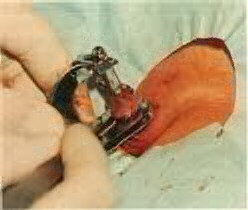

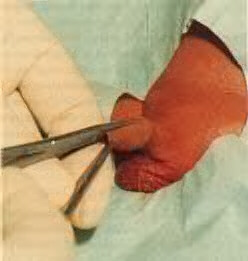

The Gomco clamp was designed to crush about 1 mm of the foreskin around the circumference, while the Gomco bell protects the head of the penis from injury during removal of the foreskin. The bell is placed inside the foreskin, and the dorsal slit is secured over the bell with a sterile safety pin. This allows the handle of the bell to pass through the circular opening of the clamp, without the foreskin slipping out. The foreskin can be brought through the opening by grasping it with sterile gauze. The thumbscrew is tightened until snug, and the visible foreskin is removed using a scalpel blade distal to the junction of the bell and the clamp. The clamp should remain secure for a total of five minutes, to allow the crush effect to be complete. This step is designed to reduce the incidence of bleeding after the clamp is removed.
When the thumbscrew is loosened and the bell gently removed from the clamp, the foreskin will stick to the bell because of the crushing. The foreskin can be loosened by gently peeling with a gauze swab to liberate the glans and show the final result. The edge of the foreskin and the corona of the penis are then gently wrapped in precut petrolatum gauze, which remains in place for 12 to 24 hours.
The Plastibell is designed to cause circumcision by cutting off the blood supply to the end of the foreskin. Dead tissue falls off 7 to 12 days after the operation. No advantages of the Plastibell technique over other techniques have been documented, except "ease of use." Some studies have shown a small increase in the incidence of infection with the Plastibell device.


Ensuring that the correct size of the Plastibell is used is important. (N.B This is done by trial of different sizes) A fit too small can cause tissue strangulation and necrosis, and one too large may result in too much foreskin being removed and the penis being denuded of skin. After making the dorsal slit as outlined for the Gomco technique, the Plastibell device is placed on the glans and the cut foreskin is pulled over the top of it.
The cut foreskin is brought over the top of the Plastibell until the tip of the incision is above the string placement guide on the device. The foreskin is clamped across the top of the Plastibell with a straight clamp. The string is placed around the foreskin and the Plastibell device in a groove that acts as a placement guide. The string is then tightened and tied in a simple square knot. An adequate result is obtained when the skin just distal to the string blanches without the string breaking. The excess foreskin is trimmed from around the bell using iris scissors . The handle is then broken off the device.
The Mogen Clamp - A blunt-edged probe is used to separate the glans from the preputial lining, taking care not to traumatize the frenulum. The prepuce is lifted upward and outward by the hemostat. This action causes the glans to retract towards the scrotum, preventing accidental amputation of the glans. The open jaws of the Mogen clamp are placed around the prepuce (grooved side facing the glans) as it is lifted upward. The clamp is closed for one to one and one-half minutes. If the infant is more than six months old, the clamp should remain closed for five minutes.
While the clamp is closed, the prepuce is cut away distal to the clamp. The clamp is then opened slowly and removed. Downward pressure is applied to the skin around the corona, until the skin-mucosal seal is broken and the glans is liberated. A blunt probe is used to remove any additional adhesions. Petrolatum gauze is applied to cover the operative site. The preputial skin around the corona of the glans will often have a "dog-eared" or asymmetric appearance. As the infant grows, this aspect becomes less prominent.
There are other methods used, e.g. the Tara Clamp, the SmartKlamp. I believe the above will give you a fair idea of the procedure, without going into further clamp details.


Of course, the infant has to be restrained, and lo! there are manufacturers who have come up with the perfect solution. One of these if Olympic Medica's very own
Infant Immobilizer Circumstraint. Fast immobilization of newborns 4-16 lbs. Use during circumcision, transfusion, minor surgery, x-ray. Complete with four adjustable Velcro straps for securing arms and legs.
"In less than 30 seconds, a nurse can immobilize the struggling infant securely in the correct position with Circumstraint. It works on a proven principle of positive 4-point restraint. Soft wide Velcro straps encircle the infants elbows and knees, depriving him/her of leverage. "


"Circumstraint's comfortable contoured shape positions the infant, hips elevated, perfectly presenting the genitalia."
"He's held safely and securely without danger of escape."
"Always a fast, easy means of immobilizing newborns for circumcision..."
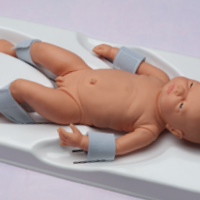
And the Stang
And the 'struggling infant' - hmm. No anaesthetic. Which I will cover in my next part of this blog, Part Three.

There are several main methods which are used to circumcise an infant, and remember I am not talking about places like Africa where there is no real hygiene and they carry out mass circumcision - with dire results.
A warning if you are squeamish - some of the pictures are graphic.
The first one I will talk about is the straight out cutting method. This is probably having its death knell sounded, although religious practices still seem to require this method. There really doesn't seem to be a standard for which method of circumcision is used, although some countries prefer the Plastibell and some the Gomco Clamp.
The so-called "simplest" method appears to have varied little from the "traditional" operation. The foreskin is pulled forwards and gripped in a pair of clamping or crushing forceps, which are placed at an angle to match the slope of the back of the glans. The skin is cut off in front of the blades of the forceps, then the inner skin is pushed back and fastened, with stitches, to the outer skin on the shaft. In infants, the stitches are often not used. Their main purpose is to close off blood vessels, and crushing with the forceps is often enough to accomplish this. How complete the circumcision is depends upon how hard the skin is pulled forward before clamping. Making the cut while the skin is pulled over the glans provides a safeguard against removing too much. Much of the inner skin remains, so the scar, after healing, will be well down the shaft. It is usually rather irregular but very inconspicuous.
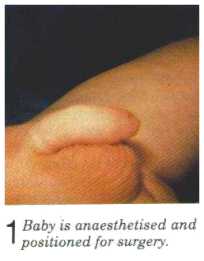 |
| NO ANAESTHETIC CAN BE USED |
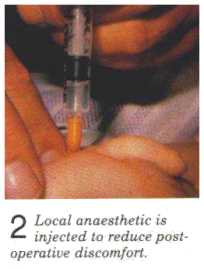 |
| Lidocaine is used. Note it is for after the operation. According to several nurses at University of Michigan, it does very little or nothing to alleviate the pain of circumcision. |
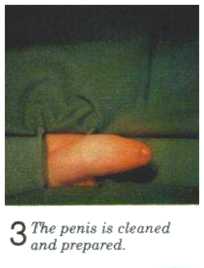 |
| Betadine is used to swab the penis and scrotum to help prevent infection |
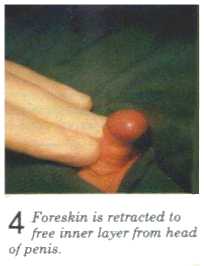 |
| The foreskin is sealed down to the penile head and must be torn off in order to be retracted in infancy. |
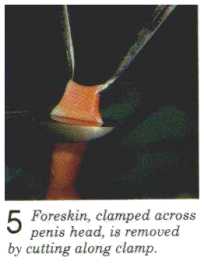 |
| The foreskin is pulled up, clamped for several minutes to prevent excess bleeding, and cut along the clamp with a scalpel. |
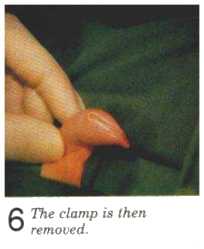 |
| What you see is not foreskin, but skin from the shaft of the penis. The edges stick together because they are still "raw". |
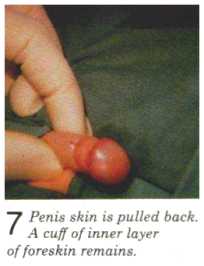 |
| The distinction between shaft skin and where the foreskin was cut away is obvious. The part of the foreskin that used to touch the glans ("inner foreskin") is what is between the shaft skin and the penile head in the picture |
 |
| Excessive bleeding is the most common complication of infant circumcision. |
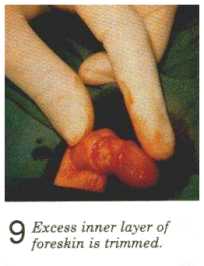 |
| After the inner foreskin is removed, notice that half the shaft skin has been cut away-- altogether,about 2/3 of all the skin of the penis. |
 |
| The remaining shaft skin is pulled up to meet the glans and attached with stitching. |
 |
| The penis now has 1/3 to 1/2 less penile skin to accommodate erections and the glans is permanently exposed. The glans will lose its shininess and dark red coloring as the site heals within the next week or so. What was before an internal part of the body, is now external and it will grow a sort of callous over the glans as part of the healing process. |
The Gomco Clamp, is an invention of Hiran Yelland and Aaron Goldstein, from 1934. It is reported to be based on the tyre lever used for Model T Ford cars. It is a metal ball, and a flat plate with a hole in it placed over both, to define the position. These are brought together by a screw and apply circular crush and fusing force - of between 8,000lbs to 20,000lbs.
Circumcision with the Gomco clamp and the Plastibell device have many of the same features. The foreskin is grasped with two mosquito clamps at the 10 o'clock and 2 o'clock positions These clamps are used to hold the foreskin up. A third mosquito clamp is used as a probe to destroy any adhesions under the foreskin from the 8 o'clock to the 4 o'clock positions and is then clamped about 2/3rd of the way between the foreskin opening and the corona. This action creates the crushed area for the dorsal slit. The third clamp remains in place for one minute. The dorsal slit is then cut through the middle of the crushed area, using tissue scissors. The foreskin is peeled back, and any additional adhesions are destroyed using a blunt probe.
The Gomco clamp was designed to crush about 1 mm of the foreskin around the circumference, while the Gomco bell protects the head of the penis from injury during removal of the foreskin. The bell is placed inside the foreskin, and the dorsal slit is secured over the bell with a sterile safety pin. This allows the handle of the bell to pass through the circular opening of the clamp, without the foreskin slipping out. The foreskin can be brought through the opening by grasping it with sterile gauze. The thumbscrew is tightened until snug, and the visible foreskin is removed using a scalpel blade distal to the junction of the bell and the clamp. The clamp should remain secure for a total of five minutes, to allow the crush effect to be complete. This step is designed to reduce the incidence of bleeding after the clamp is removed.
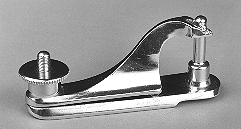 |
| Gomco Clamp |
When the thumbscrew is loosened and the bell gently removed from the clamp, the foreskin will stick to the bell because of the crushing. The foreskin can be loosened by gently peeling with a gauze swab to liberate the glans and show the final result. The edge of the foreskin and the corona of the penis are then gently wrapped in precut petrolatum gauze, which remains in place for 12 to 24 hours.
The Plastibell is designed to cause circumcision by cutting off the blood supply to the end of the foreskin. Dead tissue falls off 7 to 12 days after the operation. No advantages of the Plastibell technique over other techniques have been documented, except "ease of use." Some studies have shown a small increase in the incidence of infection with the Plastibell device.
Ensuring that the correct size of the Plastibell is used is important. (N.B This is done by trial of different sizes) A fit too small can cause tissue strangulation and necrosis, and one too large may result in too much foreskin being removed and the penis being denuded of skin. After making the dorsal slit as outlined for the Gomco technique, the Plastibell device is placed on the glans and the cut foreskin is pulled over the top of it.
The cut foreskin is brought over the top of the Plastibell until the tip of the incision is above the string placement guide on the device. The foreskin is clamped across the top of the Plastibell with a straight clamp. The string is placed around the foreskin and the Plastibell device in a groove that acts as a placement guide. The string is then tightened and tied in a simple square knot. An adequate result is obtained when the skin just distal to the string blanches without the string breaking. The excess foreskin is trimmed from around the bell using iris scissors . The handle is then broken off the device.
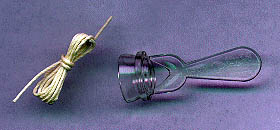 |
| Plastibell device |
The Mogen Clamp - A blunt-edged probe is used to separate the glans from the preputial lining, taking care not to traumatize the frenulum. The prepuce is lifted upward and outward by the hemostat. This action causes the glans to retract towards the scrotum, preventing accidental amputation of the glans. The open jaws of the Mogen clamp are placed around the prepuce (grooved side facing the glans) as it is lifted upward. The clamp is closed for one to one and one-half minutes. If the infant is more than six months old, the clamp should remain closed for five minutes.
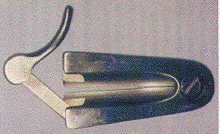 |
| Mogen Clamp |
While the clamp is closed, the prepuce is cut away distal to the clamp. The clamp is then opened slowly and removed. Downward pressure is applied to the skin around the corona, until the skin-mucosal seal is broken and the glans is liberated. A blunt probe is used to remove any additional adhesions. Petrolatum gauze is applied to cover the operative site. The preputial skin around the corona of the glans will often have a "dog-eared" or asymmetric appearance. As the infant grows, this aspect becomes less prominent.
There are other methods used, e.g. the Tara Clamp, the SmartKlamp. I believe the above will give you a fair idea of the procedure, without going into further clamp details.
Of course, the infant has to be restrained, and lo! there are manufacturers who have come up with the perfect solution. One of these if Olympic Medica's very own
Infant Immobilizer Circumstraint. Fast immobilization of newborns 4-16 lbs. Use during circumcision, transfusion, minor surgery, x-ray. Complete with four adjustable Velcro straps for securing arms and legs.
"In less than 30 seconds, a nurse can immobilize the struggling infant securely in the correct position with Circumstraint. It works on a proven principle of positive 4-point restraint. Soft wide Velcro straps encircle the infants elbows and knees, depriving him/her of leverage. "
"Circumstraint's comfortable contoured shape positions the infant, hips elevated, perfectly presenting the genitalia."
"He's held safely and securely without danger of escape."
"Always a fast, easy means of immobilizing newborns for circumcision..."
And the Stang
This light weight chair positions the infant comfortably while providing surgical access the the operative site."
"Newborn pain management is an issue
of concern to many health care
professionals today."
"Any physician or nurse who has attempted to extend the arms and legs of
a term neonate to strap him into a rigid restraint, realizes the
resistance to extension that all neonates possess.
Positioning of the
baby in the Circ Chair allows the infant to sit with his hips abducted
and flexed, knees flexed, and head elevated at various positions up to
30-45 degrees. Soft velcro straps adjust to the baby's size. The
instrument platform is designed to accommodate commonly used
circumcision clamps."
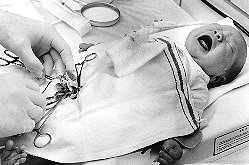 | |
| The patient cannot understand, consent, refuse or escape. |
And the 'struggling infant' - hmm. No anaesthetic. Which I will cover in my next part of this blog, Part Three.
Subscribe to:
Posts (Atom)